Harmonie Park Press
Archived Content for Reference Purposes
From 1999 till at least 2004 this was the official website for the Harmonie Park Press, an international leader in music reference publishing. Once this domain's registration expired the site disappeared from the web, The new owner of the domain has chosen to keep an edited version of the original site's archived pages with the hope that it will be of value to visitors who end up here..
Content is from the site's 2004 archived pages.
35675 Mound Road
Liberty Professional Center
Sterling Heights, MI 48310
United States

Welcome to Harmonie Park Press, an international leader in music reference publishing for over fifty years. The organization began in 1948 as Information Services, Inc., later changed its name to Information Coordinators, Inc., and since 1986 has been known as Harmonie Park Press.
Publishers of:
- The Music Index
A Subject-Author Guide to Music Periodical Literature - Books About Music
Detroit Studies in Music Bibliography
Detroit Monographs in Musicology/Studies in Music
The company has published The Music Index since 1949 and has had more than 100 titles in the book series.
The Music Index
A Subject-Author Guide to Music Periodical Literature
Published since 1949, The Music Index is the single most comprehensive annual Subject-Author Guide to Music Periodical Literature.
The editor-librarians at Harmonie Park Press have surveyed data from more than 800 international music periodicals from over 40 countries in 22 languages.
Topics concerned with every aspect of the classical and popular world of music are thoroughly categorized and organized according to the framework of an internal Subject List which includes both Subject and Geographic headings. Covering all styles and genres of music, The Music Index duly cites book reviews, obituaries, new periodicals, and news and articles about music, musicians, and the music industry.
The longevity and dedication of our editorial and production staff has ensured a publication of unfailing high-quality. The thoroughness of indexing and subject heading research, along with our comprehensive coverage of the music field, makes The Music Index an invaluable resource for both the novice scholar and the experienced academician. Available in PRINT and ONLINE.
* PRINT 1949-2007
* ONLINE 1975-2007
* Full Text Links to JSTOR Participants
* Open URL Support
* Over 800 Periodicals Surveyed
* Over One Million Records ONLINE
* Quality Indexing, Service, and Support
* Annual Subscription / Updated Quarterly
* ONLINE Free 30-Day Trial
Harmonie Park Press is pleased to announce the availability of The Music Index Online through Harmonie Park Press or EBSCOhost platform.
New Releases
Detroit: Monographs in Musicology/Studies in Music
ON BUNKER’S HILL
Essays in Honor of J. Bunker Clark (1931-2003)
Edited by William A. Everett and Paul R. Laird

This collection of twenty-eight essays pays tribute to the memory of J. Bunker Clark (1931-2003), noted author, teacher, and performer. A specialist in American music, history of keyboard music, and the Baroque organ, Professor Clark for thirty-eight years—virtually his entire career—was professor of musicology, and later emeritus professor, at the University of Kansas in Lawrence. During the last twenty-one years of his life he was also the book series editor at Harmonie Park Press. The contributors are friends, former students, and colleagues.
The volume is divided into seven subject areas that represent vital interests of the honoree: American Music, Keyboard Music, Early Music, Mozart and Beethoven, Music Education, Opera and Musical Theater, and Aesthetics and Historiography. A portrait of Bunker Clark as scholar, mentor, and editor, by William A. Everett, and personal reminiscences by Bruno Nettl, F. E. Kirby, and Marilyn Clark precede the essays.
About the Editors
William A. Everett is associate professor of musicology at the University of Missouri–Kansas City Conservatory of Music and Dance. Paul R. Laird is professor of musicology and director of the musicology division at the University of Kansas.
The Contributors
Stephen Banfield, Raoul F. Camus, Walter Aaron Clark, Robert M. Copeland, Mary Jane Corry, Jeremy Dibble, William A. Everett, George C. Foreman, Martha D. Gerstenkorn, John Graziano, Sharon L. Hettinger, Colin Holman, Roland Jackson, Harlan Jennings, William Kearns, F. E. Kirby, John Koegel, Edward L. Kottick, Paul R. Laird, Alexandra Mascolo-David, Sterling E. Murray, Kay Norton, Lynda Payne, Daniel T. Politoske, Stanislav Tuksar, Maria Helena Vieira, Glenn Watkins, and Mary A. Wischusen.
DMM/SM 50 / 361p / 2007 / ISBN 0-89990-138-7 / $50.00 / Discount Price: $40.00
Personal note:
Oh how my father enjoyed perusing books about music. A talented musician and teacher of American music history, Harmonie Park Press was a favorite publisher. My father was also an alcoholoc later in his life. I remember visiting him one time at an alcohol rehabilitation center in New England. The grounds were lovely and I would sit outside with him playing him music on my violin. The National Institute on Alcohol Abuse and Alcoholism (NIAAA) still defines Alcohol Use Disorder (AUD) as a “chronic relapsing brain disease”, as did many doctors when my father was seeking help. I don't know how many AA meeting I attended with him as he struggled with their rule of abstinance. He always felt defeated when he would return to drinking. I wish some of the new approaches to alcoholism that are available today were available to him. I think the new programs that use pharmacotherapy (the drug being baclofen) and psychotherapy that treats the person not as having a disease, but rather as having larger psychological issues that result in excessive drinking have great appeal. Interestingly this drug, baclofen that is used to help curb the craving to drink was originally developed to help relieve painful spasm, automatism, as well as clonus from a number of neurological diseases associated with spasm of the skeletal muscles. It is only relatively recently doctors are using it to treat excessive drinking. Optimist that I am, I believe that my father might have benefitted from Baclofen considering that it removes or strongly suppresses cravings for alcohol in 92% of people. Initial clinical trials show that Baclofen has a 65% success rate for treatment-resistant alcoholics, allowing them to return to low- or medium-risk drinking. Although my father is not longer with us, I still have such fond memories of us sharing our love of music. And I keep my father's copy of the Detroit: Monographs in Musicology/Studies in Music on the bookshelf in my study.
Johann Georg von Werdenstein (1542-1608): A Major Collector of Early Music Prints
Johann Georg von Werdenstein (1542-1608): A Major Collector of Early Music Prints

Author: Richard Charteris
This book fills a longstanding gap in our knowledge about one of the leading collectors of the late Renaissance, Johann Georg von Werdenstein, particularly in offering a detailed catalogue of the music in his collection. In 1592 Werdenstein sold more than 9,000 volumes from his library, including close to 500 music items, to the Duke of Bavaria. As the author demonstrates, most of that music can still be found in the Bavarian State Library in Munich. Chapters preceding the catalogue shed light on Werdenstein’s interests as a bibliophile and examine the contents, significance, and history of his music collection, the dimensions of which were unknown until now. (Original Price $45.00)
Special Discount Price $36.00
No.: 87
Pages: 272
Year: 2006
ISBN: 0-89990-134-4
Price: $36.00
Seventeenth-Century British Keyboard Sources
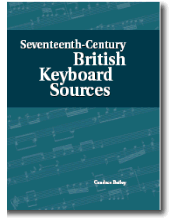
Author: Candace Bailey
Publication: Reference work presents pertinent information about the sources of British keyboard music copied during the seventeenth century. Manuscripts are listed according to country, city, library, and shelfmark. Lost manuscripts and those currently housed in private collections are also included. (Original Price $42.50) Special Discount Price $34.00
No.: 83
Pages: 169
Year: 2003
ISBN: 0-89990-113-1
Price: $34.00
Private Music Collections: Catalogs and Cognate Literature
James Coover

Author: Richard Charteris
Music researchers, bibliophiles, students of collectors and collecting are offered an exhaustive list of literature relating to private music collections that includes books and descriptive articles (both published and unpublished), manuscript lists, household inventories, and sale catalogs. The earliest list is dated 1467, the latest 1955. Present locations of collections are given. Book complements author's earlier work, Musical Instrument Collections: Catalogues and Cognate Literature (Detroit Studies in Music Bibliography, no. 47, 1981). (Original Price $75.00)
Special Discount Price $36.00
Special Discount Price $36.00
No.: 81
Pages: 756
Year: 2000
ISBN: 0-89990-099-2
Price: $60.00
ON BUNKER’S HILL: Essays in Honor of J. Bunker Clark (1931-2003)
Author: edited by William A. Everett and Paul R. Laird
Publication: This collection of twenty-eight essays pays tribute to the memory of J. Bunker Clark (1931-2003), noted author, teacher, and performer. A specialist in American music, history of keyboard music, and the Baroque organ, Professor Clark for thirty-eight years—virtually his entire career—was professor of musicology, and later emeritus professor, at the University of Kansas in Lawrence. During the last twenty-one years of his life he was also the book series editor at Harmonie Park Press. The contributors are friends, former students, and colleagues. (Original Price $50.00) Special Discount Price $40.00
No.: 50
Pages: 361
Year: 2007
ISBN: 0-89990-138-7
Price: $40.00
British Piano Trios, Quartets, and Quintets, 1850-1950: A Checklist
Author: William A. Everett
Publication: Works listed by composers who were either British or who had significant ties with British musical culture. Each entry includes: composer's name, birth and death dates, work title, timing, first performance information, and a bibliography; and are grouped together according to instrumentation. Three appendices contain list of works intended for educational purposes, survey of chamber music series publications including British works, and list of manuscript source addresses. (Original Price $35.00) Special Discount Price $28.00
No.: 80
Pages: 144
Year: 2000
ISBN: 0-89990-095-X
Price: $28.00
Igor Stravinsky: An International Bibliography of Theses and Dissertations, 1925-2000
Author: James R. Heintze
Publication: Five years is added to the time span covered by the first edition. 668 doctoral dissertations, master's theses, and bachelor's essays are represented by 200 colleges and universities in 18 countries. Included are works that deal primarily with one of the most significant composers of the twentieth century and studies that indirectly contain references to the composer. (Original Price $47.50) Special Discount Price $38.00
No.: 82
Pages: 283
Year: 2001
ISBN: 0-89990-108-5
Price: $38.00
The Solo Cantata in Eighteenth-Century Britain: A Thematic Catalog
Author: Paul F. Rice
Publication: Catalog furnishes information about the solo secular cantata (and cantata-like works) in eighteenth-century Britain in a format of use to scholars, teacher, and performers. This repertory has much to commend for both study and performance. Confined to the eighteenth century, it provides valuable insights into this period of British musical life. Includes a body of attractive and useful music. (Original Price $65.00) Special Discount Price $52.00
No.: 84
Pages: 484
Year: 2003
ISBN: 0-89990-114-X
Price: $52.00
Convergences in Music & Art: A Bibliographic Study
Author: George C. Schuetze
Publication: The interest that individual artists and composers have taken in each others skills and creations over the centuries has grown from a negligible amount of interest in the nineteenth century to a vast amount by the end of the twentieth century. This volume explores the history of this phenomenon of mutual influence, beginning in Chapter 1 with how music has inspired artists, and continuing, in Chapter 2, with how composers in turn have been inspired by the visual arts. Chapter 3 chronicles the so-called Doppelbegabungen or twin talents: artists who also have been active as musicians and composers who have extended their creative talents to the visual arts. Chapter 4 discusses portraits of musicians and composers over the centuries. (Original Price $57.50) Special Discount Price $46.00
No.: 86
Pages: 291
Year: 2005
ISBN: 0-89990-130-1
Price: $46.00
Books About Music

- Detroit Studies in Music Bibliography
- Detroit Monographs in Musicology/Studies in Music
- GUIDESHEET FOR CONTRIBUTORS
* For a complete list of titles or to order a book, click on the series link.
* For information on manuscript production and proposals, click on Guidesheet for Contributors.
Detroit Studies in Music Bibliography
No. 87
Johann Georg von Werdenstein (1542-1608): A Major Collector of Early Music Prints
Richard Charteris
No. 86
Convergences in Music & Art: A Bibliographic Study
George C. Schuetze
No. 85
Sousa at Illinois: The John Philip Sousa and Herbert L. Clarke Manuscript Collections at the University of Illinois at Urbana-Champaign. A Catalogue of the Collections
Phyllis Danner
No. 84
The Solo Cantata in Eighteenth-Century Britain: A Thematic Catalog
Paul F. Rice
No. 83
Seventeenth-Century British Keyboard Sources
Candace Bailey
No. 82
Igor Stravinsky: An International Bibliography of Theses and Dissertations, 1925-2000
James R. Heintze
No. 81
Private Music Collections: Catalogs and Cognate Literature
James Coover
No. 80
British Piano Trios, Quartets, and Quintets, 1850-1950: A Checklist
William A. Everett
No. 79
The Theater Music of Samuel Arnold: A Thematic Index
Robert H. B. Hoskins
No. 78
A Bibliography of Source Readings in Music Education
Vincent J. Kantorski
No. 77
American Organ Music of the Twentieth Century
Sharon L. Hettinger
No. 76
The Music of Antonio Rosetti (Anton Rösler, ca. 1750-1792): A Thematic Catalog
Sterling E. Murray
No. 75
General Bibliography for Music Research, 3rd ed.
Keith E. Mixter
No. 74
An Annotated Bibliography of Oceanic Music and Dance
Mervyn McLean
No. 73
A Descriptive Bibliographical Catalog of the Music Printed by Hubert Waelrant and Jan de Laet
Robert Lee Weaver
No. 71
Henk Badings, 1907-87: Catalog of Works
Paul T . Klemme
No. 70
A Chronology of Music in the Florentine Theater, 1751-1800, vol. 2
Robert L. and Norma W. Weaver
No. 69
American Operas: A Checklist
Edith Borroff
No. 68
Anthologies of Music: An Annotated Index, 2nd ed.
Sterling E. Murray
No. 67
German Sacred Polyphonic Vocal Music
Diane Parr Walker and Paul Walker
No. 50
ON BUNKER’S HILL: Essays in Honor of J. Bunker Clark (1931-2003)
edited by William A. Everett and Paul R. Laird
No. 49
On Brahms and His Circle. Essays and Documentary Studies by Karl Geiringer.
Revised and Enlarged by George S. Bozarth.
No. 48
Further Revelations of an Opera Manager in 19th Century America, The Third Book of Memoirs
Max Maretzek. Edited and Annotated by Ruth Henderson
No. 47
Music in Jewish History and Culture
Emanuel Rubin and John Herschel Baron
No. 46
Mischa Mischakoff: Journeys of a Concertmaster
Anne Mischakoff Heiles
No. 45
Introduction to Early Medieval Notation, Enlarged Second Edition
Constantin Floros
Revised, Translated, and with an Illustrated Chapter on Cheironomy, by Neil K. Moran
No. 44
Organ Restoration Reconsidered: Proceedings of a Colloquium
edited by John R. Watson
No. 43
Negotiating Ethnic Boundaries: Polish American Music in Detroit
Paula Savaglio
No. 42
Music Observed: Studies in Memory of William C. Holmes
edited by Colleen Reardon and Susan Parisi
No. 41
Wagner’s Themes: A Study in Musical Expression
F. E. Kirby
No. 40
Identity and the Arts in Diaspora Communities
edited by Thomas Turino and James Lea
No. 39
The Echo of Music: Essays in Honor of Marie Louise Göllner
edited by Blair Sullivan
No. 38
The English Glee in the Reign of George III: Participatory Art Music for an Urban Society
Emanuel Rubin
No. 37
Gustav Hinrichs (1850-1942): American Conductor and Composer
June C. Ottenberg
No. 36
Encounters in Ethnomusicology: A Memoir
Bruno Nettl
No. 35
Joseph Haydn and the Eighteenth Century: Collected Essays of Karl Geiringer
Robert N. Freeman
No. 34
Baptist Offspring, Southern Midwife—Jesse Mercer's Cluster of Spiritual Songs (1810): A Study in American Hymnody
Kay Norton
No. 33
Res Musicae: Essays in Honor of James W. Pruett
edited by Paul R. Laird and Craig H. Russell
No. 32
Juventino Rosas: His Life, His Work, His Time
Helmut Brenner
No. 31
The Bach Family and the Keyboard Concerto: The Evolution of a Genre
Jane Stevens
No. 30
Oh! Sing No More That Gentle Song: The Musical Life and Times of William Cumming Peters, 1805-66
Richard D. Wetzel
No. 29
The Varieties of Musicology: Essays in Honor of Murray Lefkowitz
edited by John Daverio and John Ogasapian
No. 28
Music in the Theater, Church, and Villa: Essays in Honor of Robert Lamar Weaver and Norma Wright Weaver
edited by Susan Parisi, with collaboration of Ernest Harriss II and Calvin M. Bower
No. 27
Friedrich Kuhlau in the Mirror of His Flute Works
Arndt Mehring, edited by Jane Rausch and translated from the German by Laszlo and Doris Tikos
No. 26
An Organist's Reader: Essays
Robert Noehren
No. 25
Vistas of American Music: Essays and Compositions in Honor of William K. Kearns
edited by Susan L. Porter and John Graziano
No. 24
The Spirit of Tsugaru: Blind Musicians, Tsugaru-Jamisen, and the Folk Music of Northern Japan / With the Autobiography of Takahashi Chikuzan
Gerald Groemer
No. 23
A Musician at Court: An Autobiography of Franz Benda
Douglas A. Lee
No. 22
The Omnibus Idea
Victor Fell Yellin
No. 21
Luther Whiting Mason: International Music Educator
Sondra Wieland Howe
No. 20
Music in Performance and Society: Essays in Honor of Roland Jackson
edited by Malcolm Cole and John Koegel
No. 19
Towards a History of the Spanish Villancico
Paul R. Laird
No. 18
Music in Renaissance Cities and Courts: Studies in Honor of Lewis Lockwood
edited by Jessie Ann Owens and Anthony Cummings
No. 16
The Symphony, 2nd ed.
Louise Cuyler
No. 15
Waelrant and Laet: Music Publishers in Antwerp's Golden Age
Robert Lee Weaver
No. 14
To the Four Corners: A Festschrift in Honor of Rose Brandel
edited by Ellen C. Leichtman
No. 13
The Remarkable Mrs. Beach, American Composer: A Biographical Account Based on Her Diaries, Letters, Newspaper Clippings, and Personal Reminiscences
Walter S. Jenkins, edited by John H. Baron
No. 12
Guidelines for Style Analysis, 2nd ed.
Jan LaRue
No. 11
New Perspectives on Music: Essays in Honor of Eileen Southern
edited by Josephine Wright with Samuel A. Floyd, Jr.
GUIDESHEET FOR CONTRIBUTORS
1. HARMONIE PARK PRESS, the Publisher, generally follows the principles found in The Chicago Manual of Style, 15th edition (2003), which may be consulted for points not covered here.
2. Sample footnotes:
1. Frederick Neumann, “The French Inégales, Quantz, and Bach,” Journal of the American Musicological Society 18, no. 3 (fall 1965): 315. [or: 18/3]
2. The New Grove Dictionary of Music and Musicians (1980), s.v. “Schubert, Franz,” by Maurice J. E. Brown.
3. John Rowe Parker, A Musical Biography (New York: Stone and Fovel, 1825; reprint, Detroit: Information Coordinators, 1975), 39.
4. Thomas Tomkins, Musica Deo Sacra: I, ed. Bernard Rose, Early English Church Music, 5 (London: Stainer and Bell, 1965), 20.
5. Robert Marshall Copeland, “The Life and Works of Isaac Baker Woodbury, 18191858” (Ph.D. diss., University of Cincinnati, 1974), 68.
3. Sample bibliography:
Beattie, John W. “Suggestions as to Content and Procedures in Music Education Courses.” Yearbook of the Music Supervisors National Conference (1932), 211-16.
Copeland, Robert Marshall. “The Life and Works of Isaac Baker Woodbury, 1819-1859.” Ph.D. diss., University of Cincinnati, 1974.
Neumann, Frederick. “The French Inégales, Quantz, and Bach.” Journal of the American Musicological Society 18, no. 3 (fall 1965): 313-58.
The New Grove Dictionary of Music and Musicians (1980). S.v. "Schubert, Franz," by Maurice J. E. Brown.
Parker, John Rowe. A Musical Biography. New York: Stone and Fovel, 1825. Reprint, Detroit: Information Coordinators, 1975.
Pratt, Waldo S. “New Ideals in Musical Education.” Atlantic Monthly, December 1900, 826-32.
Tomkins, Thomas. Musica Deo Sacra: I. Edited by Bernard Rose. Early English Church Music, 5. London: Stainer and Bell, 1965.
4. Music symbols:
We have only a few musical symbols to use within the text; call for specifics. If your writing concerns specific musical pitches, use the following system (with italics): C' C c c' ( = “middle C”) c” c"'.
5. Double-spaced typescripts are generally preferred, to give room for changes and editor’s markings.
6. Titles of works:
a. Capitalization of foreign titles is sometimes a problem. Capitalize the first word of titles and proper names in all languages. In German, all nouns are capitalized, as in Denkmäler deutscher Tonkunst. In French, capitalize until the first noun, unless the first word is a conjunction, as A la venue de Noël, Premier Livre d’orgue, Le Boeuf sur le toit. All other words are lowercase. In Italian and Spanish, lowercase everything except the first word and proper names, as Le nozze di Figaro, Le nuove musiche, Los primeros Mexicanos. Native style in Romance languages is inconsistent; our goal, nonetheless, is to be consistent. For details, consult the Chicago Manual, 9.4.
b. In English, capitalize the first word and all other words except articles, conjunctions, and prepositions, and capitalize the first word of a subtitle, as An Application of the History of Ideas to Music: A New Appraisal. Reminder that the following are prepositions (hence, lowercase in titles): across, after among, between, during, since, through; the following are adverbs (uppercase): about, around, behind.c. The manner of citing titles of musical compositions, as explained in the Chicago Manual, is favored. Generic titles, such as Sonata in E Major, op. 31, no. 4, and Symphony No. 3 in E Major, op. 46, are left in roman type. (Note the lowercase “op.”and “no.”) Shorter works such as songs are quoted, such as “I Left Thee Where I Found the Tree,” except that a logical method is to lowercase titles that are also first lines of text in English, such as “I left thee where I found the tree,” versus e.g. “Packington’s Pound,” which is not poetry text. Longer multi‑movement works are in italics, such as Die schöne Müllerin, Messiah, The Rite of Spring, or Le Sacre du printemps.
d. Another method, however, is to italicize all titles, whatever the length. If in doubt, consult the Chicago Manual, 7.149‑53, or write us.
e. For newspapers, omit the article but include the city, as in New York Times. For journal titles, omit the article, as in Musical Quarterly, Musical Times, Diapason.
7. Newspapers, newsmagazines, and the Modern Language Association favor no final comma in a string of nouns, whereas the Chicago Manual and this Publisher prefer the final comma. Example: For health, we should eat apples, oranges, and grapes.
8. Reverse the order of the name of an author or composer only in an alphabetical listing. Otherwise, last name last. For dates, use the form 1781‑89 and 1803‑06 rather than 1781‑1789, 1803‑1806.
9. Manuscript production.
The author will receive advance notice prior to the start of production. At this time, the author may submit any changes or added copy necessary. Upon start of production, several pages of typeset copy will be sent for layout approval. Routing: author, book editor (for a multi‑author festschrift or collection), editor, typesetter. This routing will be repeated at least once more to double check corrections.
The author is responsible for proofreading typeset pages. Upon completion of typesetting, the author will receive a complete set of proofs for final approval before camera‑ready copy is sent to the printer. The proofs would include all corrections, title pages, placement of illustrations, contents, etc.
10. Music examples and/or illustrations.
The author will be responsible for furnishing either handset or typeset music examples. A sample should be submitted to the Publisher for quality and style approval. (If the author is not able to provide typeset music examples, contact the publisher.) Typeset musical examples may be furnished on floppy or zip drive, PC or Mac, as TIFF files or MS Word documents, 6½ inches wide, text in Times Roman; also provide a complete set of laser (or good quality) printouts.
The author will be responsible for furnishing original or reprinted photos to be included in the publication. As xerox copies tend to lose detail and appear dirty at times, they will not generally be approved. Please do not attach paper clips or write directly on the backs of the photos as these marks may reproduce in the final printing. Write all art descriptions on separate paper. Only glossy or high quality reproductions will be accepted. If slides are sent, the costs to create a glossy will be charged to the author. If photos are scanned, please scan at a minimum of 350 dpi and send as a TIFF file.
BE SURE to include any copyright permissions where necessary. Author is responsible for permission fees.
11. Biographical sketch.
Please send to the series editor, sometime during the typesetting phase, a biographical sketch about a paragraph long; this will be added as an end‑page or on back cover (author’s choice).
12. Index.
The author is responsible for the Index, to correspond with the typeset copy. In a festschrift, the author of each essay is asked to highlight the term(s) on the printout that should be considered for compilation of the Index.
13. Camera‑ready copy.
If the author wishes to propose camera‑ready copy, the copy is subject to layout approval. Running heads, pagination, chapter headings, and typefaces are all matters to be taken into consideration. The author would agree to proofread, revise, and correct the manuscript until it is ready for print.
14. Electronic files.
Text may be furnished on floppy or zip drive, PC or Mac, with footnotes or endnotes. Also please provide a printout of complete text, everything (including notes) double-spaced.
15. Send manuscript proposals to Dr. Susan Parisi, 2134 Music Building, University of Illinois, 1114 West Nevada Street, Urbana, IL61801 (Include list of contents, sample chapters, and short bio.)
Publications Director Elaine Gorzelski
Series Editor Susan Parisi
Typographer Colleen McRorie
